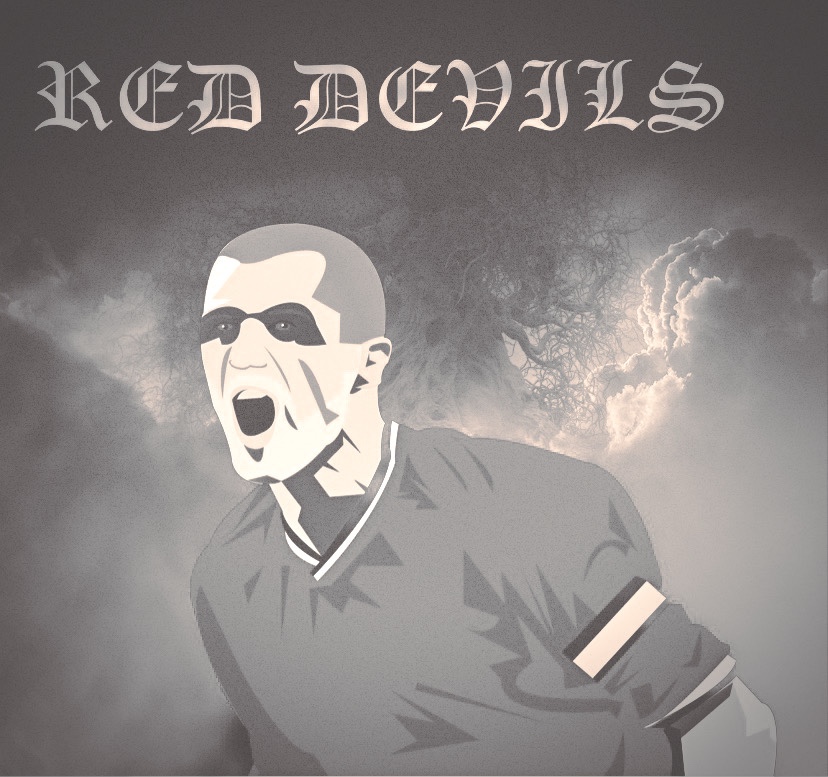
For over 50 years, a red devil has adorned Manchester United’s club crest. The reason is the same one Norway’s black metal scene had for identifying with the devil. Fear gave them the upper hand. Now the fear is completely gone from the red half of Manchester, what happened?
In 1958, Matt Busby’s golden team was a charming success story. The “Busby Babes” became a phenomenon across England after two consecutive league titles (1956, 1957), with an average age of 22. The local lads were handsome, skillful, and above all very, very good. On February 6, 1958, it all came to a tragic end. Eight players died, and Matt Busby himself was permanently injured. United would come back, but the nickname “Busby Babes” stayed behind in Munich.
The devil on the chest
This time, Busby himself wanted to take control of his own club’s nickname. The reason was obvious, but also carefully chosen with performance in mind.
In Salford, a district of Manchester not far from United’s home ground, it was the rugby team that had made a name for itself in Europe. With their red shirts and intense style of play, the French journalist covering the Manchester rugby team’s demolition of their local heroes had no choice — the opponents simply became victims of the red devils. The name stuck, and it remains attached to this day.
With “the Red Devils,” Sir Matt Busby got everything he wanted. He got a name that wasn’t rooted in the players but in the local community — and, not least, he got a name and an image that obligated his own players to play with an attitude and style to match. That made them a team opponents had to fear. When you faced United, you didn’t face 11 players — you faced 11 devils. Representatives of the worst of the worst. Evil itself.
The devil, or Satan, simply means “the adversary.” In religion, the devil is God’s adversary, humanity’s adversary, and goodness’s adversary. Fear of the evil adversary was long very real. People feared that evil would take hold of them and destroy them. Fear of the devil was immense — not just fear of eternal torment in hell, but of what the devil could inflict here and now, before death. In this way the devil commanded enormous respect. You didn’t mess with the devil or the demonic. For a long time, merely uttering the devil’s name was considered daring. Just talking about evil was a way to shock people. But sport has always operated by slightly different rules. Few in 1970s Britain would have gotten away with the same message: “Satan — that’s us!”
Lords of Chaos
Sport wasn’t the only place where the power of identifying with Satan was visible. While the hard rock bands of the ’70s and ’80s had stuck to singing about the devil, a gang of Norwegian “outcasts” in the ‘90s took it all the way — they were on evil’s side, they were Satan incarnate!
Bands like Mayhem, Emperor, and Darkthrone set the standard for a whole new genre: black metal. Along with the black-and-white aesthetic, the bleak atmosphere, and a raw sound, credibility and seriousness were absolutely vital. They were true bearers of chaos, destruction, and evil. They were 100% Satanists. Society was to be broken down through evil, fear, and violence. This resulted in several church burnings and eventually several murders. Fear spread among large parts of the Norwegian population, and with it came a kind of respect. The guys with long black hair became a force that authorities couldn’t quite control.
Among United’s devil-worshippers, there wasn’t much fear to be found through the ‘70s. The devil had entered the emblem, but on the pitch, “The Red Devils” were tame. Then Alex Ferguson arrived at the club, and fear once again became central to the club’s identity, both internally and externally.
In hindsight, it’s clear Ferguson valued his brutal player types, and even when things sometimes crossed the line, he kept his devils — even when intensity tipped over into violence. Cantona kicked and struck a spectator but returned straight away as captain. The same applied to Roy Keane after his horror tackle on Alf-Inge Håland. Peter Schmeichel shouted and shoved, Jaap Stam was eager with the “chokeholds.” Wayne Rooney, as a striker, picked up 101 yellow cards during his time at the club — by comparison, Steven Gerrard has 61, and he was a midfielder.
Facing United was meant to hurt, and if necessary, be downright dangerous.
Sir Alex also managed to build a constructive culture of fear internally. Fear of the manager created a loyalty and discipline few teams could match. You either followed orders, or you were finished. This gave the team enormous strength and instilled fear in everyone they faced, no matter how deep into stoppage time the clock ticked. United always came back. Fear walked ahead of them, giving them an enormous competitive advantage.
Fred the Red and the death of fear
With success came marketing and branding. Here, of course, the devil was celebrated for all it was worth — but no longer in the service of fear. The new mascot, Fred the Red, wasn’t a fearsome devil but more of a Teletubby with horns, used before matches but also on merchandise aimed at children. Now Satan was on baby bottles, cuddly toys, and lunchboxes. There wasn’t much threatening about that.
On the pitch, the fear factor held up right until Ferguson stepped down in 2013.
Now United, much like Norway’s once-feared devil-worshippers, have become a joke. The fear is gone, and with it, the power that came with it. Where opponents could once forget about hoping for more than a single point at Old Trafford, now victory is possible for anyone, no matter who you are.
The players are no longer feared but rather seen as clowns. Even those who were supposed to be the “hard men” — like Fellaini, Jones, and Maguire — have simply become people everyone pokes fun at.
Will it ever be like it once was?
 Fotballguden.no
